

Table of Contents
- What Healthy Fitness Balance Actually Means
- Balancing Cardio and Strength Training
- Rest and Recovery for Christians
- How to Integrate Prayer Into Workouts
- Building Daily Habits That Keep Fitness Balance
- Progressive Overload for Balance and Stability
- Common Mistakes That Break Fitness Balance
- Conclusion
- Frequently Asked Questions
Last Updated: September 16, 2026
What Healthy Fitness Balance Actually Means
Healthy fitness balance is the practice of distributing training stress, recovery, nutrition, and spiritual discipline so that no single element crowds out the others. This guide from IsaacTempleNutrition treats fitness balance as stewardship: your body is a temple, and stewards do not run one room into the ground while the rest sits neglected.
The Four Pillars of Fitness Balance
Four pillars hold a sustainable routine together:
- Training load, resistance work, cardio, and mobility spread across the week
- Recovery, sleep, rest days, and deliberate downtime
- Nutrition, consistent daily coverage, not perfection
- Spiritual practice, prayer and gratitude woven into the routine, not bolted on
Balancing Cardio and Strength Training
Alternate hard cardio and hard strength days rather than stacking them, and treat mobility work as the connective tissue between the two. A common mistake is chasing both at maximum intensity in the same session, which leaves recovery short and progress flat. The CDC physical activity guidelines call for at least 150 minutes of moderate-intensity aerobic activity and two or more days of muscle-strengthening activity each week, that is the floor, not the ceiling, and it is the number to build your split around.
Why Order and Spacing Matter
When you train hard cardio and hard strength back to back, the cardio session can blunt the strength adaptation, a pattern researchers call the interference effect. It is most pronounced with long, high-volume endurance work paired with heavy lower-body lifting. You do not need to avoid combining them, but you should separate the hard efforts by at least six hours when possible, or put them on different days.
A Sample Weekly Split
| Day | Focus | Intensity |
|---|---|---|
| Monday | Strength (lower body) | Hard |
| Tuesday | Easy cardio | Light |
| Wednesday | Mobility and stretching | Light |
| Thursday | Strength (upper body) | Hard |
| Friday | Interval cardio | Hard |
| Saturday | Walk or active recovery | Light |
| Sunday | Rest and prayer | None |
The pattern matters more than the specific exercises. Hard days earn easy days, and easy days make hard days possible.
Scaling the Split to Your Goal
The 2-and-2 template is a starting point, not a rule. Adjust the ratio based on what you are training for:
- General health and longevity: keep the 2-and-2 split and prioritize consistency over volume
- Fat loss: add one or two easy cardio sessions (walks, cycling, rowing) rather than converting strength days to cardio, preserving muscle keeps your resting metabolism higher
- Strength or muscle gain: keep cardio to two short sessions and place them as far from leg day as your schedule allows
- Endurance events: cardio volume will dominate for a training block, and strength work drops to one or two maintenance sessions per week
Aerobic Exercise and Its Impact on Stability
Cardio is not just a heart and lung stimulus, it directly supports balance. Walking, cycling, and swimming train the coordination and postural control that keep you upright, and regular aerobic activity is one of the most consistent factors associated with lower fall risk as you age. The practical takeaway: do not treat cardio as the enemy of balance work.
A Note on Mobility
Mobility work is the cheapest recovery tool you have. Ten minutes of hip, ankle, and thoracic mobility on your easy days improves squat depth, gait quality, and the range of motion your balance work depends on. It will not show up in your numbers this week, but skipping it for a month will show up in your knees.
Rest and Recovery for Christians
A magnesium supplement taken in the evening supports muscle relaxation and sleep quality, which is why IsaacTempleNutrition's Magnesium Glycinate fits naturally into a recovery-focused routine. It is not a shortcut. It is one input among several that support the repair side of the equation.

How to Integrate Prayer Into Workouts
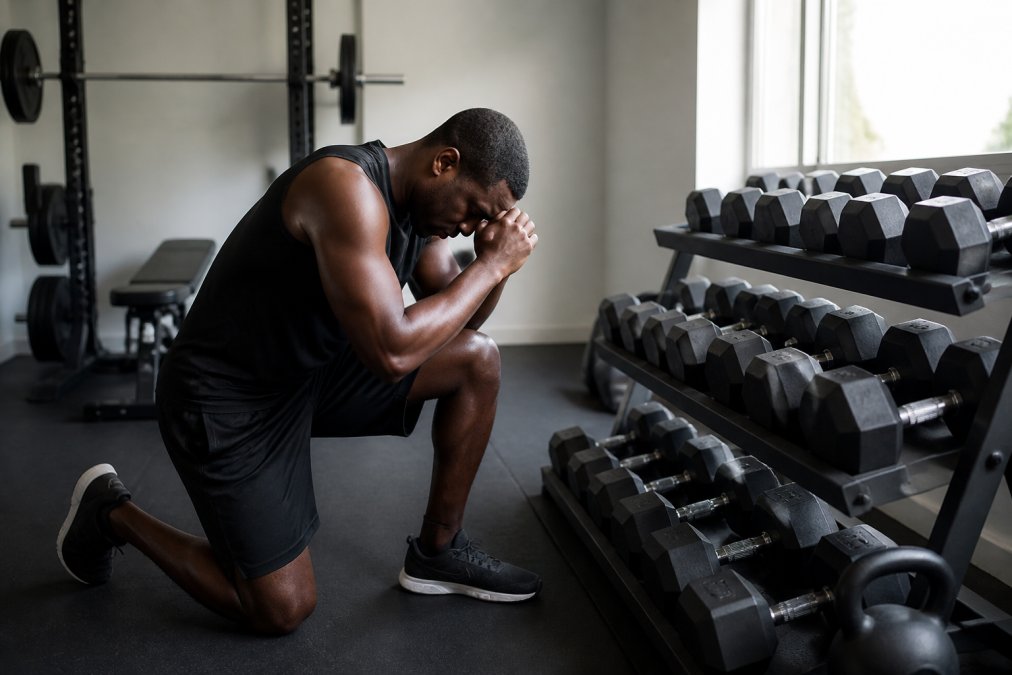
Prayer integrates into training through rhythm, not ritual. Attach short prayers to fixed points in the session: before the first set, between blocks, and after the final rep. The structure of a workout already provides the cue, so no extra time is required.
Simple Ways to Pray During Training
- Before the first set: a brief prayer of gratitude for the ability to move
- Between sets: a single sentence of intercession for someone else
- During rest periods: a short passage of Scripture, repeated
- After the session: thanks for the work completed, regardless of performance
The goal is not intensity of feeling. It is consistency of attention. A routine that includes prayer tends to hold together longer because it serves a purpose larger than personal performance.
Building Daily Habits That Keep Fitness Balance
Habits outlast motivation, so build the routine around anchors you already keep. Pair training with an existing daily event, such as the start of the morning or the end of the workday, and the decision to train disappears.
Progressive Overload for Balance and Stability
Progressive overload for balance means increasing difficulty in small, deliberate steps rather than adding weight alone. Balance adapts to challenge, so the progression comes from reducing support, narrowing your base, adding movement, or removing sensory input. This is the mechanism most programs miss: your body maintains balance through three inputs, vision, the inner ear, and proprioceptors in your joints and muscles.
A practical sequence, ordered from easiest to hardest:
- Two-legged stance with eyes open, held for time
- Two-legged stance with eyes closed
- Single-leg stance with eyes open
- Single-leg stance with eyes closed
- Single-leg stance on a folded towel or cushion
- Weight shifting and reaching while balancing on one leg
- Single-leg stance with head turns or slow arm reaches
- Single-leg stance on a cushion while passing an object hand to hand
When to Advance
Most practitioners find that a position is ready to progress when you can hold it for 30 seconds with steady breathing and no wobble that requires a step or grab. If you cannot reach 30 seconds, hold what you can and repeat for three sets rather than forcing the next step. The American College of Sports Medicine recommends balance training two to three days per week for older adults, and that frequency works well for younger adults building a base too.
Equipment-Free Home Modifications
You do not need a balance pad or a wobble board. Household items scale the challenge safely:
- A folded bath towel creates an unstable surface for single-leg work
- A throw pillow adds more instability than a towel but less than a foam pad
- A sturdy chair back or kitchen counter is your handhold for the earliest progressions and your safety net when you push into harder ones
- A doorway frame gives you two handholds at shoulder height for eyes-closed work
- A rolled yoga mat works as a narrow beam for heel-to-toe walking
- A paperback book balanced on your head trains posture and spinal alignment during stance work
Safety Tips for Balance Training
- Train near a wall, counter, or chair, every time, not just when you feel unsteady
- Keep the surface dry and wear shoes or go barefoot on a non-slip floor; socks on hardwood are a common cause of slips
- Start with eyes-open work and only close your eyes once the open-eye version is solid for 30 seconds
- Stop if you feel dizzy, lightheaded, or experience vertigo, balance training should feel challenging, not disorienting
- If you have a history of falls, neuropathy, or inner-ear conditions, clear the program with your physician before starting
How This Connects to Strength
Lower body strength and core strength support every position on that list. Weak hip abductors and ankle stabilizers are two of the most common reasons people plateau on single-leg work, so a few sets of lateral band walks, calf raises, and glute bridges each week will move your balance numbers faster than more balance drills alone. Strength training for the legs remains the foundation underneath all of it, balance is what strength does under unstable conditions.
Common Mistakes That Break Fitness Balance
The most common mistake is treating balance as a single skill rather than a system. People add a balance drill and expect the rest of the routine to hold, then wonder why progress stalls.
Watch for these:
- Skipping mobility work because it feels unproductive, which gradually reduces range of motion and gait quality
- Training through fatigue to protect a streak, which trades long-term progress for a short-term record
- Neglecting posture during daily activities, which undoes hours of training
- Ignoring recovery signals such as persistent soreness or poor sleep
- Letting fitness become an idol, where training displaces prayer, family, and rest
Conclusion
The hard part of fitness balance is not knowing what to do. It is keeping the four pillars in proportion across months and years, through busy seasons and slow ones. That requires discipline, and it requires the right fuel.
Frequently Asked Questions
What is the 3-3-3 rule for fitness?
The 3-3-3 rule is a simple way to structure a balanced week: three days of strength training, three days of cardio or aerobic exercise, and three intentional rest or mobility days. It keeps you from overtraining one system while neglecting others. For faith-driven athletes, it also leaves room for prayer and reflection on rest days, helping fitness balance stay sustainable rather than obsessive.
How can I balance spiritual discipline with physical training?
Treat both as parts of the same routine instead of competing priorities. Schedule training blocks and prayer blocks on the same calendar, and let one feed the other. Many people pray during warm-ups, between sets, or on walks. Rest and recovery for Christians fits naturally here, since Scripture treats rest as wisdom rather than weakness, and a planned rest day becomes an act of stewardship rather than laziness.
How do I prevent burnout while pursuing fitness goals?
Watch for the early signs: poor sleep, nagging soreness that never fades, dread before workouts, and skipped sessions you used to enjoy. Cut training volume by about a third for one week, protect one full rest day, and add a magnesium glycinate supplement in the evening to support muscle relaxation and sleep. If motivation stays low, revisit your why and bring it back to stewardship rather than performance.
What causes poor physical balance?
Balance depends on coordination, core strength, lower body strength, and proprioception, the body's sense of where it is in space. It declines with inactivity, muscle loss, inner-ear problems, certain medications, and poor posture. Strength training, single-leg stance work, and heel-to-toe walking all train these systems. Practicing barefoot on a firm floor at home is one of the simplest equipment-free ways to improve stability over time.