

Table of Contents
- What You'll Need Before Your First Workout
- How to Start Fitness as a Beginner: Step 1 - Set Realistic Goals and Choose Activities You Enjoy
- Step 2 - How to Start Slowly and Build Gradually with Warm-Up and Cool-Down
- Sample 1-Week Beginner Workout Plan for Weight Loss
- How to Stay Consistent with Exercise When Motivation Fades
- Essential Supplements for Beginners: What to Consider
- Common Mistakes to Avoid When Starting Fitness
- Frequently Asked Questions
Last Updated: September 13, 2026
What You'll Need Before Your First Workout
Starting fitness as a beginner requires less gear than most people think: supportive shoes, comfortable clothing, a water bottle, and a realistic idea of your current activity level. Everything else can wait.
The barrier isn't equipment or knowledge, it's the mental weight of doing it "right." You don't need a gym membership, a trainer, or a perfect plan, just a decision and a first session.
This guide from IsaacTempleNutrition walks through the exact steps to start fitness as a beginner, from setting goals to building a weekly routine that sticks, treating your body as entrusted to you, not something to punish into shape.
For context on what "enough" activity actually looks like, the Physical Activity Guidelines for Americans recommend at least 150 minutes of moderate-intensity aerobic activity per week for adults, plus two days of muscle-strengthening work.
Before your first workout, answer three questions honestly:
- What does your current week look like? (Work hours, sleep, family commitments)
- What physical activity have you done in the past six months?
- What time of day could you realistically protect for exercise?
Write the answers down. They shape everything that follows.
How to Start Fitness as a Beginner: Step 1 - Set Realistic Goals and Choose Activities You Enjoy
Two decisions determine whether you'll still be training in six months: goal-setting and activity selection.
Setting Realistic Fitness Goals
Realistic goals are specific, time-bound, and small enough to hit. "Get fit" is not a goal. "Walk briskly for 20 minutes, three times this week" is.
A common mistake is aiming for the finish line in week one, beginners who run five miles on day one often quit once soreness fades. Progressive overload works only when the starting point is genuinely easy.
Try this framework:
- Week 1-2: Establish the habit. Three sessions of 15-20 minutes each.
- Week 3-4: Add five minutes per session.
- Week 5-8: Introduce light resistance training twice weekly.
Choosing Activities You Enjoy
The best exercise is the one you'll repeat. Enjoyment isn't a luxury; it's the mechanism that makes consistency possible.
If you dread the treadmill, don't build your plan around it. Brisk walking, cycling, swimming, dance workouts, and bodyweight circuits all count as legitimate aerobic exercise, and low-impact options suit people with joint concerns or higher body weight.
Step 2 - How to Start Slowly and Build Gradually with Warm-Up and Cool-Down
Building gradually means increasing duration before intensity, and never skipping the warm-up or cool-down. Most beginner injuries trace back to doing too much, too soon, without preparation.
The Importance of Warming Up and Cooling Down
A warm-up raises core temperature and heart rate, increases blood flow to working muscles, and primes the nervous system so joints and connective tissue are ready for load. Cold, stiff tissue tolerates force poorly, which is why strains most often happen on the first hard effort.
A practical beginner warm-up runs 5-10 minutes and moves from general to specific:
- 2-3 minutes of easy cardio, brisk walk, marching in place, or easy cycling to raise heart rate.
- 3-5 minutes of dynamic stretching, leg swings (front-to-back and side-to-side), arm circles, hip circles, walking lunges, and bodyweight squats through a full range of motion.
- 1-2 minutes of rehearsal, one light set of whatever you're about to do, at roughly half your working effort.
The cool-down mirrors it: 3-5 minutes of easy walking or slow pedaling to bring your heart rate down, then static stretching.
Dynamic vs. Static Stretching: What Goes Where
This is the distinction most beginner guides blur.
- Dynamic stretching involves controlled movement through a joint's range, leg swings, arm circles, walking lunges, cat-cow. It belongs before training because it raises temperature and prepares tissue without reducing force output.
- Static stretching involves holding a position still, typically 20-30 seconds per muscle group. It belongs after training, when muscles are warm, because prolonged static holds before activity can temporarily reduce power and stability.
If you only remember one rule: move before, hold after.
Progressive Overload and Avoiding Injury
Progressive overload means adding a small challenge each week: a few more minutes, a slightly heavier weight, or one extra repetition. The key word is small.
A practical rule: increase one variable per week by no more than 10 percent. If you walked 60 minutes last week, aim for 66, not 120. Change one variable at a time, duration, intensity, or frequency, so you can tell what your body is responding to.
Gauge effort with the talk test: at moderate intensity you can hold a conversation but not sing; at vigorous intensity you can only speak a few words before a breath. Beginners should spend most of their time at moderate.
Sample 1-Week Beginner Workout Plan for Weight Loss
A beginner weight loss plan works best when it combines moderate-intensity cardio, basic resistance training, and genuine rest. Here's a week you can start tomorrow.
| Day | Activity | Duration | Focus |
|---|---|---|---|
| Monday | Brisk walking | 25 min | Aerobic base |
| Tuesday | Bodyweight circuit (squats, push-ups, rows) | 20 min | Muscle-strengthening |
| Wednesday | Rest or light stretching | 15 min | Recovery |
| Thursday | Brisk walking or cycling | 25 min | Cardiovascular health |
| Friday | Bodyweight circuit | 20 min | Resistance training |
| Saturday | Activity you enjoy (swim, dance, hike) | 30 min | Enjoyment and endurance |
| Sunday | Rest | - | Rest and recovery |
What the Bodyweight Circuit Actually Looks Like
Two sessions a week is the beginner standard for muscle-strengthening. Here's a no-equipment circuit for home:
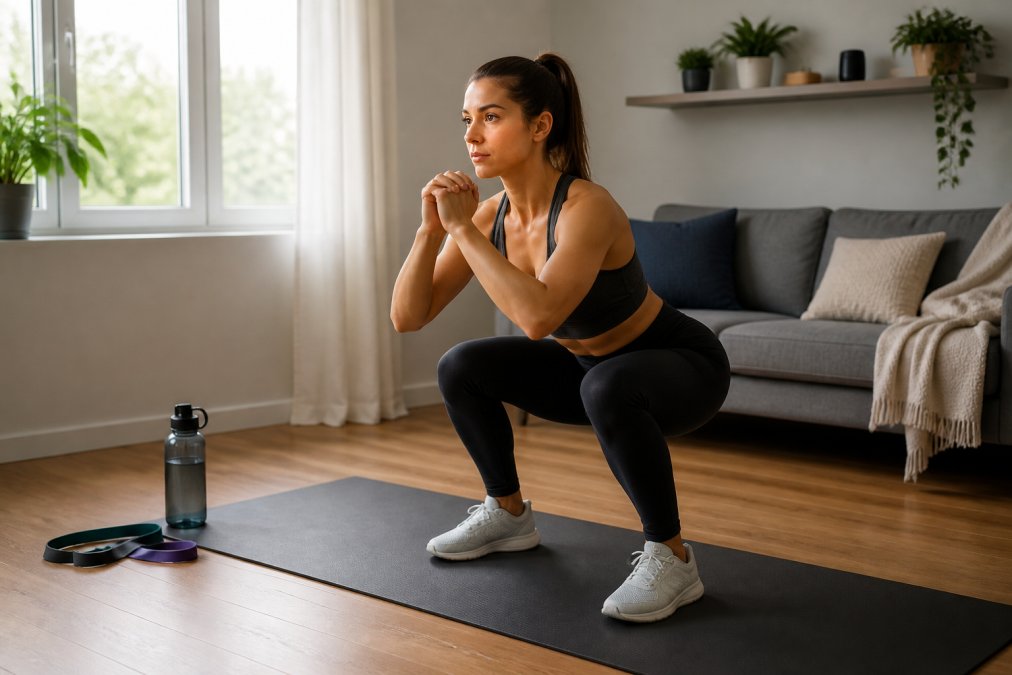
- Bodyweight squats, 8-12 reps. Sit back as if into a chair, knees tracking over toes. Scale down by holding a countertop for balance; scale up by slowing the descent to three seconds.
- Incline push-ups, 6-10 reps. Hands on a counter, table, or wall. The higher the surface, the easier. Scale up by lowering the surface over weeks.
- Bent-over rows with a band or dumbbell, 8-12 reps per side. Hinge at the hips, keep your back flat, pull the elbow toward your ribs.
- Glute bridges, 10-12 reps. Lie on your back, feet flat, lift the hips by squeezing the glutes. A strong option for anyone with knee sensitivity.
- Dead bugs or bird dogs, 6-8 reps per side. These train the core without loading the spine.
Rest 60-90 seconds between rounds and complete two or three rounds. If you can't finish the reps, drop to the lower end next time.
How to Progress This Week Over 8 Weeks
- Weeks 1-2: Run the week exactly as written. The goal is showing up, not intensity.
- Weeks 3-4: Add five minutes to each cardio session and one rep to each strength exercise.
- Weeks 5-6: Add a third round to the circuit and one extra walking day if you feel recovered.
- Weeks 7-8: Introduce a light pair of dumbbells or a heavier resistance band for the rows and squats.
Recommended Weekly Activity Duration and Intensity
The target is 150 minutes of moderate-intensity aerobic activity weekly, plus two muscle-strengthening sessions.
Beginners can split this into short sessions: three 10-minute walks count the same as one 30-minute walk for cardiovascular health. Frequency matters more than duration early on.
A Note on Weight Loss Specifically
Exercise alone rarely drives significant weight loss, activity, nutrition, and sleep together move the scale. A realistic beginner expectation is roughly 0.5 to 2 pounds per week, a range that depends far more on diet than any single workout (the CDC). The value of this plan is that it builds the habit and muscle that make the nutrition side easier to sustain.
How to Stay Consistent with Exercise When Motivation Fades
Consistency comes from systems, not willpower. Motivation is starting fuel, not an engine, people who stick with exercise long-term have routines that survive bad days.
Overcoming Barriers and Gymtimidation
Gymtimidation, the anxiety many beginners feel about being watched or judged in a fitness setting, is one of the most common reasons people never start.
The fix is often to start at home. Bodyweight exercises, resistance bands, and a pair of adjustable dumbbells cover most beginner needs without an audience. When you do return to a gym, go during off-peak hours for the first few visits.
Other common barriers and their practical fixes:
- No time: Split workouts into 10-minute blocks.
- Too tired: Schedule exercise earlier in the day, before decisions pile up.
- Boredom: Rotate three or four activities instead of repeating one.
- Cost: Home training removes the monthly fee entirely.
Habit Formation and Rest and Recovery
A habit forms through repetition in a stable context. Pick a consistent time and place. Lay out your clothes the night before. Track sessions with a simple checkmark on a calendar.
Rest and recovery are part of the program, not a break from it. Sleep, hydration, and at least one full rest day weekly protect against overtraining.
Essential Supplements for Beginners: What to Consider
Essential supplements for beginners are simple: a multivitamin, protein powder, creatine, and electrolytes cover the vast majority of needs. Nothing exotic is required.
At IsaacTempleNutrition, we built our product line around this idea: fuel the body with clean, transparently labeled products so training supports the whole person, not just performance metrics. A few options:
- Complete Multivitamin ($32.90) fills nutritional gaps that most diets leave open, supporting daily immune and energy needs.
- Advanced 100% Whey Protein Isolate ($49.00) helps beginners hit protein targets when food alone falls short.
- Creatine Monohydrate ($33.90) is the most researched strength supplement available, useful even for those just starting resistance training.
- Hydration Powder (Passion Fruit) ($34.99) replaces electrolytes lost during sweaty sessions.
Beginners don't need all four. Start with a multivitamin and protein if your diet is inconsistent. Add creatine once you're training with resistance twice weekly.

Budget-Friendly Home Equipment Alternatives
You can build a complete beginner setup for well under a year's gym membership:
- A yoga mat for floor work and stretching
- One pair of adjustable dumbbells
- A set of resistance bands
- A jump rope for cardio
That's it. Everything else is optional until you've trained consistently for three months.
Fitness for Specific Body Types or Limitations
Training should adapt to your body, not the other way around. People with knee sensitivity often do better with cycling, swimming, or glute-focused strength work than running; those carrying more weight may prefer low-impact cardio to protect joints.
If you have a diagnosed condition or injury history, get clearance from a physician before starting. The CDC's guidance on physical activity and health offers useful context on how activity interacts with common health conditions.
Common Mistakes to Avoid When Starting Fitness
Most beginner mistakes are predictable, and avoidable:
- Doing too much in week one. Soreness is not a measure of progress. Start easier than feels impressive.
- Skipping the warm-up. Cold muscles tear more easily. Five minutes of preparation prevents weeks of recovery.
- Ignoring rest days. Recovery is when adaptation happens. Train through it and you'll stall.
- Chasing intensity over consistency. Three moderate sessions beat one brutal session followed by five days off.
- Comparing yourself to experienced lifters. Their year five is not your week one.
- Buying everything before starting. Gear does not create habits. Start with what you have.
One missed session isn't a failed week. Missing Monday doesn't mean skipping Thursday.
Starting fitness as a beginner is less about finding the perfect program and more about showing up consistently with a plan that respects where you are today. IsaacTempleNutrition exists to support that work with clean, faith-aligned supplements, from our Complete Multivitamin for daily nutritional coverage to Advanced 100% Whey Protein Isolate and Creatine Monohydrate for strength support. Train with intention, recover well, and steward the body you've been given. Get started with IsaacTempleNutrition and fuel your first 90 days with purpose.

Frequently Asked Questions
Is it good to exercise as soon as I wake up?
Morning workouts can help you stay consistent because fewer distractions arise early in the day. However, your body may be stiffer, so a longer warm-up with dynamic stretching is important. If you prefer afternoon or evening sessions, that works too. The best time is when you will actually do it regularly. For beginners, aim for moderate-intensity activity like brisk walking or bodyweight exercises, and listen to your body's energy levels.
What are 7 exercises I can do every day as a beginner?
You can safely do these seven bodyweight exercises daily: squats, push-ups (on knees if needed), lunges, glute bridges, planks, jumping jacks, and marching in place. They cover major muscle groups and get your heart rate up. Start with 2 sets of 8-12 reps for each, resting as needed. As you get stronger, add reps or sets. This routine supports cardiovascular health and muscle-strengthening without equipment.
How do I stay motivated to exercise as a beginner?
Focus on habit formation rather than motivation. Schedule workouts like appointments, track your progress, and celebrate small wins. Find an accountability partner or join a community. Remember your deeper purpose, such as honoring your body as a temple. When you miss a day, don't quit; just resume the next day. Consistency over perfection builds lasting change.
What should a beginner eat before and after a workout?
Before a workout, eat a light snack with carbs and protein, like a banana with peanut butter, 30-60 minutes prior. After training, aim for a mix of protein and carbs within an hour to support recovery. A whey protein isolate shake with fruit works well. Stay hydrated with water or an electrolyte drink. For beginners, whole foods should form the base, and supplements can fill gaps. Always prioritize consistency in your overall diet.